
Curated Networks vs Open Marketplaces: What I Learned The Hard Way
This question keeps coming up for a reason.
Most founders don’t wake up thinking, “Maybe I should rethink how I hire freelancers today.” That thought usually comes after something goes wrong.
A deadline slips.
A freelancer slowly disengages.
The work looks fine on the surface, but doesn’t actually move the needle.
Or worse — the project technically finishes, but it doesn’t really work.
And when that happens, most people blame talent.
But over time, I realised it’s usually not a talent problem.
It’s a structure problem.
This isn’t about saying one model is superior. Open marketplaces exist for a reason. Curated networks exist for a reason. They were built to solve different types of problems.
The mistake happens when we use the wrong system for the kind of work we’re trying to get done.
So instead of ranking them or trashing either side, let’s break down how each one is designed, where each works well, where each quietly struggles, and how to decide what fits your situation.
The Two Models (Without The Marketing Spin)
If you strip away the branding, most freelance platforms fall into two buckets:
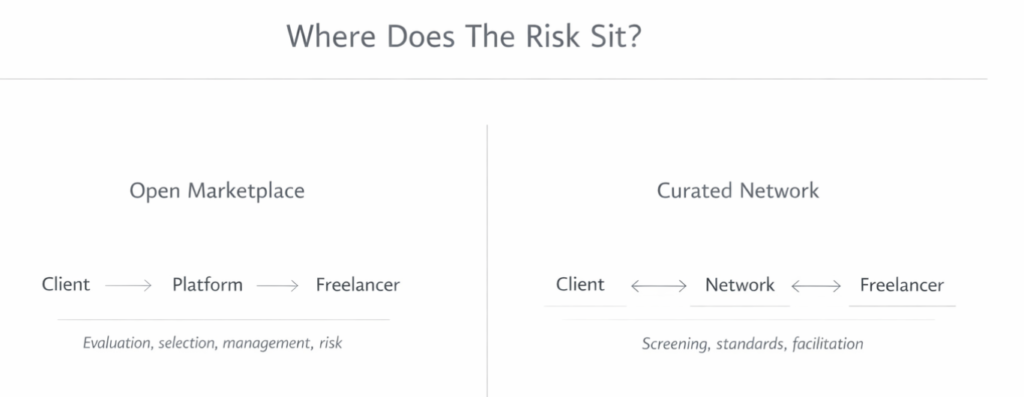
Open marketplaces are built for access and scale.
Anyone can join. Anyone can post. The system rewards activity — profiles, bids, messages, transactions.
Curated networks are built for selection and reliability.
Entry is reviewed. Participation is restricted. The system prioritises fit, standards, and outcomes over sheer volume.
Neither design is accidental.
But their incentives are very different.
And incentives shape behaviour.
How Open Marketplaces Actually Work
Open marketplaces optimise for three things:
- Large supply
- High activity
- Fast transactions
To make that happen, friction is removed everywhere.
Freelancers can join easily.
Clients can post jobs quickly.
Matching happens through browsing, bidding, or algorithms.
But here’s the key part most people overlook:
Responsibility sits heavily on the buyer.
You are responsible for screening.
You are responsible for choosing.
You are responsible for onboarding.
You are responsible for managing.
When this works, it works very well.
Open marketplaces shine when:
- The task is clearly defined
- The risk is low
- Speed matters more than precision
- You’re experienced at managing freelancers
- A failed hire won’t hurt too badly
In these scenarios, abundance is an advantage.
More options can mean better pricing and faster turnaround.
But abundance also has side effects.
The Hidden Cost Of Too Many Options
When you’re staring at 80 profiles that all “look decent,” something interesting happens.
Choice increases.
Confidence doesn’t.
You spend more time comparing than deciding.
Signals start to blur.
Everyone says similar things in slightly different ways.
And because the platform’s job is access — not accountability — the risk quietly shifts to you.
If the project drifts, that’s on you.
If communication breaks down, that’s on you.
If quality varies wildly, that’s on you.
Again, this doesn’t make open marketplaces bad.
It just defines their trade-offs.
They are excellent at facilitating transactions.
They are not built to absorb risk.
How Curated Networks Are Designed Differently
Curated networks start from a different assumption:
Not all work benefits from scale.
Instead of maximising participation, they restrict it.
Instead of encouraging browsing, they encourage selection.
Instead of stepping back after the match, they often stay involved.
You’ll typically see:
- Reviewed entry rather than open sign-up
- Intentional introductions instead of endless browsing
- Clear expectation-setting before work begins
- Ongoing standards enforcement
Volume is lower.
Reliability is higher.
This model works better when:
- The work has material consequences
- The cost of failure is high
- You don’t have time to manage every detail
- Long-term collaboration matters
It’s not about prestige.
It’s about risk tolerance.
Matching vs Facilitating
One difference that isn’t talked about enough is the role of the intermediary.
Open marketplaces match.
They connect both sides — then step aside.
Curated networks often facilitate.
They stay closer to the relationship. They reduce ambiguity. They help align expectations.
And here’s why that matters:
Most projects don’t fail at hiring.
They fail during execution.
Scope drifts.
Communication degrades.
Priorities change.
Assumptions misalign.
If the system disappears after the introduction, you’re left solving those problems alone.
If the system anticipates those issues, friction reduces over time.
That design difference is subtle, but powerful.
Where Each Model Struggles
Open marketplaces tend to struggle when:
- The work requires deep context
- Continuity matters
- You don’t have time to actively manage
- Quality variance becomes expensive
Curated networks tend to struggle when:
- Speed is the only priority
- The work is experimental or disposable
- You want aggressive price competition
- Flexibility matters more than consistency
Understanding these limits is more useful than arguing about which model is “better.”
Scale vs Consistency
Scale is easy to measure.
Consistency is harder.
Marketplaces grow by increasing participation.
Networks grow by protecting standards.
As systems scale, behaviour changes.
When growth depends on volume, incentives drift toward activity.
When growth depends on trust, incentives drift toward restraint.
That’s why some platforms feel noisy over time.
And others feel quieter — but steadier.
Neither outcome is accidental.
How To Decide What Fits You
Instead of asking:
“Which platform is the best?”
Ask yourself:
- How much risk can we tolerate?
- How much time can we spend managing freelancers?
- What happens if this hire goes wrong?
- Do we need more options — or more confidence?
If your answers lean toward speed, experimentation, and low consequence, open marketplaces often make sense.
If your answers lean toward reliability, accountability, and long-term outcomes, curated networks usually fit better.
Final Thought
Most hiring frustration isn’t caused by bad freelancers.
It’s caused by systems being used outside their design limits.
Open marketplaces and curated networks are built differently because they optimise for different things.
Once you understand the structure behind each, your decision becomes much clearer.
Not because it guarantees success.
But because you stop taking avoidable risks.