
Freelancer or System Risk
Most founders won’t admit this publicly.
But behind closed doors?
A lot of them quietly believe freelancers are the problem.
A project goes south and the story sounds familiar.
The freelancer disappeared.
Deadlines slipped.
Quality dropped.
Replies slowed down.
Accountability felt… blurry.
So the emotional conclusion becomes:
“Freelancers are risky.”
It feels true because you’ve experienced it.
But from what I’ve seen, that conclusion is incomplete.
Over the years, whether in SEO, printing, or running a studio, I’ve worked with freelancers. Some were fantastic. Some weren’t. But when I looked closely at failed engagements, a pattern started to emerge.
Most breakdowns weren’t caused by bad freelancers.
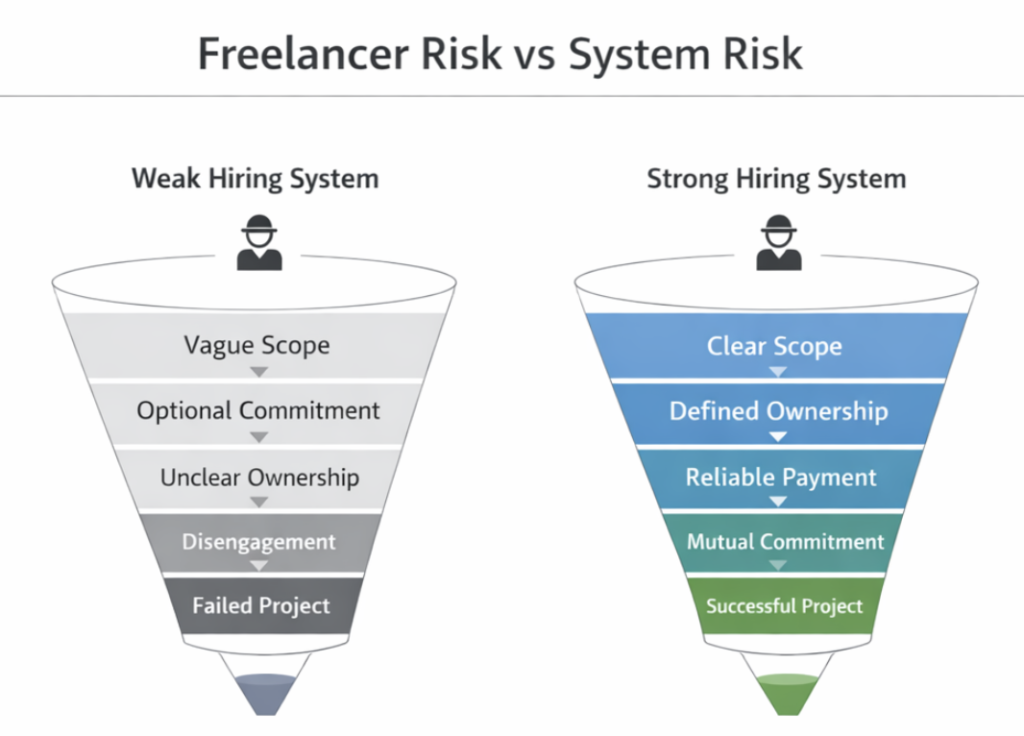
They were caused by weak hiring systems.
This isn’t a defence of freelancers. Poor performers exist everywhere — full-time hires included.
But if you zoom out and look at patterns instead of isolated incidents, the real issue becomes clearer.
The risk isn’t freelancers.
It’s how most teams hire them.
The Pattern Most Teams Miss
When companies describe a failed freelance hire, it usually sounds like this:
- The profile looked strong
- The interview felt fine
- The rate was reasonable
- The platform felt “safe enough”
And yet… execution collapsed.
What rarely gets examined is the environment the freelancer was placed into.
Was the scope clearly defined?
Was ownership obvious?
Was there a shared definition of success?
Was payment predictable?
Was there structure beyond a chat thread and a loose deadline?
In many cases, the honest answer is no.
Good freelancers don’t fail in isolation.
They fail inside systems that make commitment optional, accountability vague, and continuity fragile.
Why Strong Freelancers Avoid Certain Setups
The best freelancers develop pattern recognition.
They know which signals lead to smooth engagements and which ones lead to chaos.
That’s why many of them avoid environments like:
- Open bidding wars where price matters more than context
- Endless shortlists with no real decision maker
- Vague scopes framed as “we’ll figure it out along the way”
- Payment structures that feel discretionary
- Clients who treat hiring as reversible at any moment
Not because they lack flexibility.
But because those setups create asymmetric risk.
The freelancer commits time and reputation upfront.
The client keeps optionality.
When that imbalance exists, strong professionals quietly opt out.
What remains often isn’t the best talent.
It’s the talent most tolerant of uncertainty.
How Bidding Culture Erodes Professionalism
Open marketplaces normalise a specific behaviour loop.
Speed over depth.
Volume over fit.
Exposure over assurance.
Freelancers are rewarded for replying fast, lowering prices, and promising flexibility.
Clients are rewarded with choice — but not necessarily confidence.
Over time, both sides adjust.
Freelancers stop investing deeply before commitment because it’s risky.
Clients get used to replacing people easily.
What looks like flexibility becomes transactional behaviour with shallow buy-in.
Projects move forward.
But no one is fully anchored.
Why Disengagement Happens
Ghosting is usually framed as a character flaw.
From what I’ve observed, it’s often a system symptom.
Disengagement tends to appear when:
- Scope keeps shifting without acknowledgment
- Decision-making authority isn’t clear
- Feedback loops are inconsistent
- Payment timing becomes uncertain
- The work feels provisional rather than real
Under those conditions, even responsible freelancers subconsciously reduce commitment.
Not out of malice.
Out of self-preservation.
Professional energy follows signals of seriousness.
How Credible Freelancers Evaluate Clients
Strong freelancers don’t just evaluate the task.
They evaluate the system.
They pay attention to:
- How decisions are made
- How quickly ambiguity is resolved
- Whether expectations are explicit
- Whether payment feels procedural, not personal
- Whether there is continuity beyond one task
When those signals are present, commitment rises naturally.
Not because of contracts alone.
But because trust feels mutual.
The Myth of Flexibility
“Flexibility” sounds attractive in freelance hiring.
But unstructured flexibility is just uncertainty wearing better branding.
When everything is adjustable, nothing is anchored.
The strongest freelancers I’ve worked with prefer clarity over freedom.
They would rather operate within a defined frame than constantly renegotiate expectations.
Systems that confuse looseness with adaptability unintentionally increase risk.
Fewer Matches. Stronger Outcomes.
Hiring systems optimised for scale prioritise availability.
Hiring systems optimised for outcomes prioritise readiness.
There’s a difference.
When fewer introductions are made, more responsibility exists on both sides to make them work.
Selection replaces browsing.
Commitment replaces experimentation.
Accountability stops being abstract.
What Actually Reduces Freelance Risk
From experience, risk drops when:
- Screening is thoughtful, not superficial
- Matching is intentional, not purely automated
- Payment is reliable and procedural
- Expectations are aligned early
- Responsibility doesn’t disappear after introduction
Notice something.
These are system decisions.
Not freelancer personality traits.
Reframing The Question
Instead of asking:
“Can freelancers be trusted?”
A better question is:
“What kind of system are we placing them into?”
That question predicts outcomes far more accurately than ratings, resumes, or portfolio screenshots.
Final Thought
Freelancers aren’t the weak link in modern work.
Weak hiring systems are.
When structure supports trust, professionals show up.
So the real question isn’t whether freelancers are risky.
It’s whether your hiring system deserves commitment.