Why Hiring Freelancers Feels Harder Than It Should
Most teams don’t struggle with freelancers because freelancers are unreliable.
They struggle because of how freelancers are hired on freelance platforms.
And this is something most people only realise after getting burned once or twice.
You hire quickly.
You feel good about the profile.
You’re impressed by the portfolio.
Then a few weeks later, you’re managing misalignment, fixing missed expectations, or quietly thinking, “This is more work than I thought.”
If you’ve ever:
- Hired fast and spent weeks cleaning up after
- Been impressed by profiles but underwhelmed by delivery
- Felt overwhelmed by options yet strangely unsure about your final choice
- Or wondered why something that felt “easy” at the start became stressful later
You’re not alone.
And it’s probably not a talent problem.
The Problem Isn’t Talent. It’s The Environment.
There are incredibly skilled freelancers out there today.
Designers. Engineers. Marketers. Analysts.
Many of them are genuinely excellent at what they do.
But hiring still feels risky.
So teams jump to the wrong conclusion:
“Freelancers are unreliable.”
What I’ve seen over time is different.
The risk usually doesn’t come from the individual.
It comes from the system used to hire them.
Most large freelance marketplaces are built to optimise for:
- Volume
- Speed
- Activity
- Transactions
Not for:
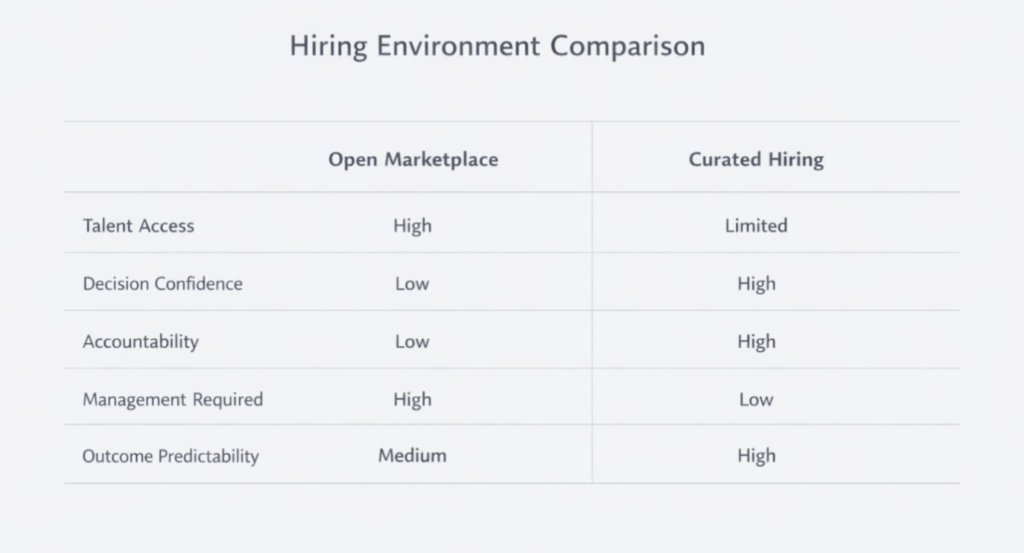
- Decision confidence
- Accountability
- Long-term fit
- Consistent outcomes
When a system is designed for transactions instead of trust, even good people can struggle to produce good results.
The Illusion Of Choice
At first, marketplaces feel empowering.
Thousands of profiles.
Endless filters.
Instant access.
It feels like control.
But abundance creates a different problem.
When everything is available, nothing feels certain.
More profiles = more comparison fatigue.
More bids = more noise.
Faster hiring = lower commitment on both sides.
What feels like flexibility is often just hesitation.
A lot of hiring decisions end up being made not because someone is clearly the right fit, but because they are “good enough” and available now.
And that cost shows up later.
“Let’s Just Try Them” Is More Expensive Than It Sounds
One of the most common approaches I see is experimental hiring.
“Let’s give them a small task.”
“If it doesn’t work, we’ll switch.”
“We can always replace them.”
On the surface, that feels safe.
In reality, it increases:
- Context loss
- Rework
- Management time
- Internal frustration
And freelancers can feel that lack of commitment too.
When commitment is low:
- Ownership drops
- Prioritisation shifts elsewhere
- Engagement becomes transactional
What looks flexible often becomes fragmented.
When Nobody Really Owns The Outcome
In many open marketplaces, responsibility is split.
The platform provides access.
The client chooses.
The freelancer delivers.
When something goes wrong, everyone shares a bit of the responsibility — which means no one fully owns it.
Disputes become procedural.
Escalations replace conversations.
Rules replace judgment.
It’s not malicious design.
It’s just what happens when systems are built around access instead of outcomes.
What Experienced Teams Do Differently
After going through enough cycles, stronger teams stop asking:
“How fast can we hire?”
They start asking:
- How confident are we in this decision?
- Who owns accountability here?
- How much management will this require from us?
- Can this relationship scale beyond one task?
And then they change one key thing.
They reduce noise before engagement.
They stop browsing.
They start selecting.
Selection means fewer options — but higher conviction.
It feels slower at the beginning.
But it saves time over months.
Why Curated Hiring Feels Different
When you introduce constraints on purpose — limited access, human vetting, fewer introductions — something shifts.
In curated environments:
Freelancers protect their reputation more seriously.
Clients decide with more clarity.
Expectations are set before work begins.
Curation isn’t about exclusivity for ego.
It’s about alignment.
When incentives are aligned, behaviour changes.
The Hidden Cost Of Hiring Noise
Every extra profile reviewed.
Every restart.
Every replacement.
These costs rarely show up on a P&L.
But they show up as:
- Slower execution
- Team fatigue
- Lost momentum
- Lower internal trust
Hiring chaos compounds quietly.
You don’t feel it immediately.
You feel it three months later.
Hiring Is A System, Not A Transaction
Freelancers aren’t interchangeable units.
They respond to clarity.
To structure.
To incentives.
When hiring is treated like a commodity transaction, quality becomes fragile.
When hiring is treated like a structured relationship, reliability improves.
That difference isn’t luck.
It’s design.
Final Thought
Hiring freelancers doesn’t have to feel chaotic.
But it will if the system is built for volume instead of confidence.
The most reliable teams don’t make more hiring decisions.
They make fewer decisions, better.
And once they experience that shift, they don’t go back.