
Why This Guide Exist
Over the years, whenever clients hire freelancers, almost every conversation starts the same way.
They talk about speed.
They talk about cost.
They talk about access to talent.
Very few talk about trust.
Even fewer talk about accountability.
Almost no one talks seriously about payment structure.
But ironically, those are the exact areas where freelance engagements break.
When things go wrong, the explanation is usually vague:
- “The freelancer disappeared.”
- “The client kept changing the scope.”
- “Payment became messy.”
- “No one wanted to take responsibility.”
It’s easy to assume someone was incompetent or dishonest.
But most of the time?
It’s not bad people.
It’s weak systems.
This guide is for founders and team leads who want to understand where trust actually breaks, why payment disputes happen even when both sides are capable, and what structures reduce risk — without turning everything into corporate bureaucracy.
No hype.
No platform comparisons.
Just how this works in the real world.
Trust Doesn’t Collapse Overnight
Here’s something most people don’t realise.
Freelance engagements rarely explode dramatically.
They slowly fade.
The early warning signs are subtle:
- Replies take longer.
- Deliverables come with less explanation.
- Expectations are “assumed” instead of clarified.
- Both sides feel slightly uneasy… but keep going.
By the time there’s a visible conflict, trust has already been eroding for weeks.
And here’s the key insight:
Trust in freelance work isn’t built on friendliness.
It’s built on predictability.
When freelancers clearly know:
- What success looks like
- How decisions are made
- How scope changes are handled
- When and how they’ll be paid
They behave differently.
And when clients clearly know:
- Who owns delivery
- What happens if something slips
- How disputes are handled
- Whether there’s a neutral structure involved
They make better decisions earlier.
Trust isn’t emotional.
It’s operational.
Why “Good People” Still End Up Fighting
One of the biggest myths seen is this:
“If both sides are good people, things will work out.”
Not necessarily.
Most disputes happen because:
- Scope was never properly defined
- Responsibility was ambiguous
- Incentives were misaligned
- Payment mechanics were unclear
Let me paint a common scenario.
A freelancer starts with a rough brief.
The client says, “Let’s figure it out as we go.”
Both mean well.
The first few deliverables look fine.
Then priorities shift.
The client asks for revisions.
The freelancer feels the scope is expanding.
The client feels the changes are reasonable.
No one is unethical.
But now:
- The freelancer feels exposed.
- The client feels frustrated.
- Payment becomes the pressure point.
Trust doesn’t collapse because of bad intent.
It collapses because there’s no structure to fall back on.
Payment Is More Than Money
Payment structure shapes behaviour long before money moves.
When payment is:
- Unclear
- Delayed
- Informal
- Tied to vague milestones
Freelancers subconsciously manage risk.
They may:
- Limit effort
- Avoid deep ownership
- Prioritise other clients
On the client side, unclear payment setups often trigger:
- Micromanagement
- Last-minute pressure
- Withholding approval “just in case”
Now both sides feel unsafe.
The irony?
Most freelancers and clients want the same thing — a clean outcome.
Payment reliability isn’t about generosity.
It’s about confidence.
Why Platforms Often Feel “Neutral”
Most freelance platforms are built to solve one core problem: access.
They’re excellent at:
- Listing profiles
- Enabling messaging
- Processing payments
But they struggle with:
- Owning delivery outcomes
- Interpreting nuance
- Handling complex disputes
Not because they don’t care.
Because accountability doesn’t scale easily.
When thousands or millions of users are involved, responsibility gets diluted. Disputes become procedural. Decisions rely on templates.
The result is a strange middle ground:
- Freelancers feel unsupported.
- Clients feel exposed.
- The platform stays neutral.
Neutral sounds fair.
But in practice, neutrality often means no one truly owns the outcome.
Intermediaries: Good vs Bad
Intermediaries get a bad reputation — and honestly, some deserve it.
Bad intermediaries:
- Add friction without clarity
- Take fees without real protection
- Insert themselves into communication unnecessarily
But good intermediaries do something very specific.
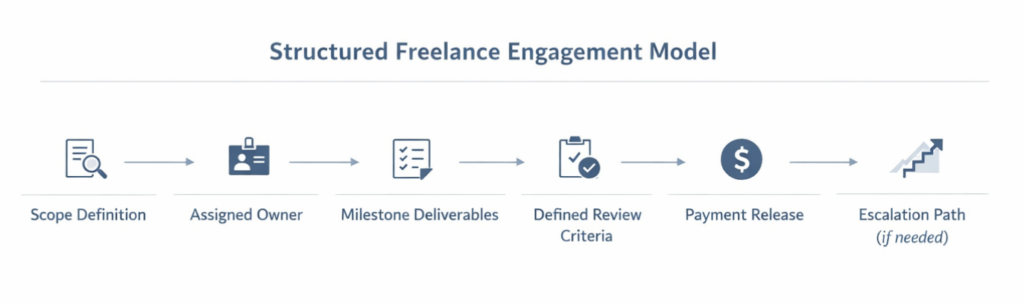
They own the structure.
That includes:
- Clear contracting
- Defined scope boundaries
- Structured payment handling
- Clear escalation paths
When structure is strong, emotional debates reduce.
Instead of asking:
“Is this fair?”
Both sides ask:
“What does the agreement say?”
That alone prevents many conflicts from escalating.
Shared Responsibility Is Dangerous
One of the most fragile setups in freelance work is shared responsibility without a clear owner.
When everyone is “in charge,” no one is.
Accountability works when:
- Expectations are explicit
- Authority is clear
- Consequences are known
This doesn’t mean heavy management.
In fact, clarity often reduces oversight.
Freelancers who understand where responsibility sits tend to:
- Communicate earlier
- Flag risks sooner
- Take more pride in the outcome
Clients who know who owns delivery tend to:
- Intervene less
- Trust more
- Move faster
Structure Protects Freelancers Too
Many people assume structure mainly benefits clients.
In reality, strong freelancers benefit even more.
Clear systems protect freelancers from:
- Scope creep disguised as collaboration
- Payment delays framed as “internal process”
- Emotional pressure during delivery
The strongest freelancers I’ve seen actively choose environments where:
- Expectations are documented
- Payment is reliable
- Decision-making is predictable
They’re not chasing volume.
They’re choosing stability.
Dispute Resolution Shouldn’t Be Personal
The best dispute systems don’t focus on blame.
They focus on resolution.
That means:
- Clear timelines
- Defined review criteria
- Neutral evaluation when needed
Most conflicts don’t escalate when:
- Scope is documented
- Changes are tracked
- Payment is milestone-based and clearly understood
And when disputes do happen, process prevents them from becoming personal.
What Mature Teams Optimise For
Teams that consistently succeed with freelancers stop optimising for speed alone.
They optimise for:
- Fewer, higher-quality engagements
- Strong upfront alignment
- Clear payment mechanics
- Predictable accountability
They stop chasing the cheapest option.
They start valuing confidence.
Ironically, this often reduces total cost — even if individual rates are higher.
Final Thought
Trust, accountability, and payment aren’t side topics in freelance work.
They are the work.
When these are treated as operational foundations instead of afterthoughts, freelance engagements stop feeling risky.